Skript vs Java Plugins: Which Should You Use?
Skript and Java plugins both customise a Paper server, but they suit different jobs. Skript gets ideas live in minutes; Java gives full control and the best performance. This comparison looks at workflow, speed, reach and maintenance, shows the same feature written both ways, and explains how many servers end up using the two together.
 SkriptPlugin Editorial TeamIndependent Skript guides
Updated Published 4 min read
SkriptPlugin Editorial TeamIndependent Skript guides
Updated Published 4 min read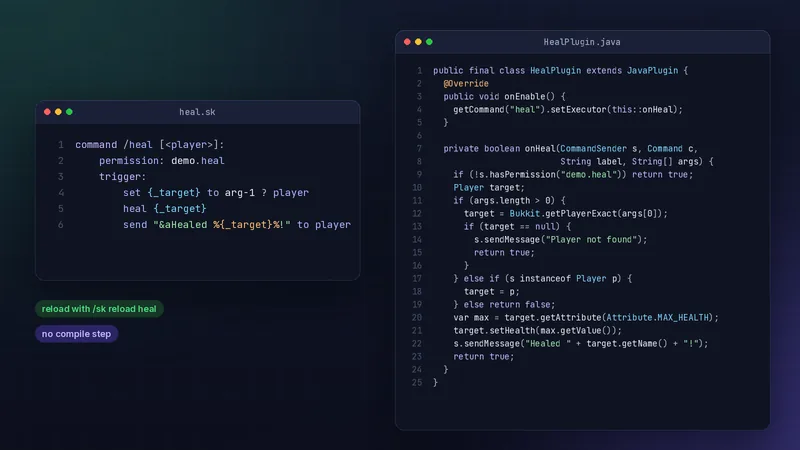
The short answer
Pick Skript when
You want custom commands, join flows, rewards, light game rules or staff tools, and you value changing them quickly. Skript is also the better learning tool: instant feedback, readable code and no build setup.
Pick Java when
The feature runs constantly, handles lots of data, must be unit tested, or will be maintained by developers for years. Java also wins when you need APIs that Skript and its addons do not expose.
Development workflow compared
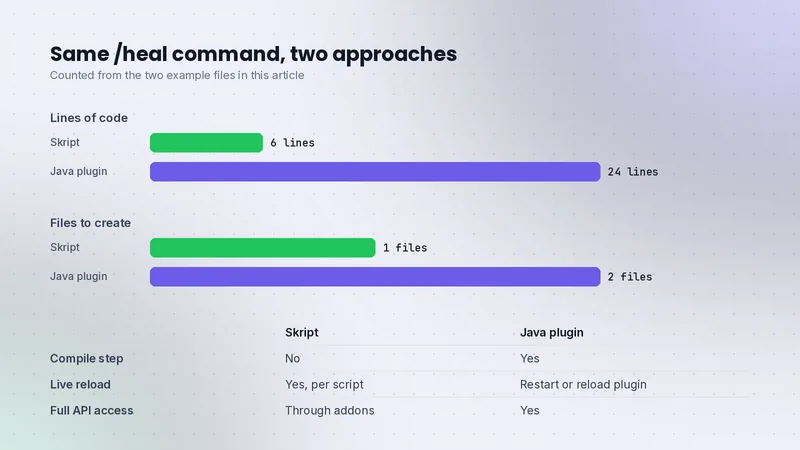
Here is a /heal command with an optional target, written both ways.
command /heal [<player>]:
    permission: demo.heal
    trigger:
        set {_target} to arg-1 ? player
        heal {_target}
send "&aHealed %{_target}%!" to playerpublic final class HealPlugin extends JavaPlugin {
@Override
public void onEnable() {
getCommand("heal").setExecutor(this::onHeal);
}
private boolean onHeal(CommandSender s, Command c,
String label, String[] args) {
if (!s.hasPermission("demo.heal")) return true;
Player target;
if (args.length > 0) {
target = Bukkit.getPlayerExact(args[0]);
if (target == null) {
s.sendMessage("Player not found");
return true;
}
} else if (s instanceof Player p) {
target = p;
} else return false;
var max = target.getAttribute(Attribute.MAX_HEALTH);
target.setHealth(max.getValue());
s.sendMessage("Healed " + target.getName() + "!");
return true;
}
}Writing and reloading
The Skript version is edited in any text editor and applied with /sk reload heal. The Java version also needs a plugin.yml, a build with Gradle or Maven, and a server restart to load the new jar. For a small feature, that difference is minutes against seconds.
Tooling, testing and version control
Java has mature tooling: IDE autocomplete, refactoring, debuggers and unit tests. Skript scripts are plain text, so version control works fine, but testing is mostly manual on a test server. Skript does include its own test framework for contributors, though most server owners will not use it.
Performance in practice
Where the overhead comes from
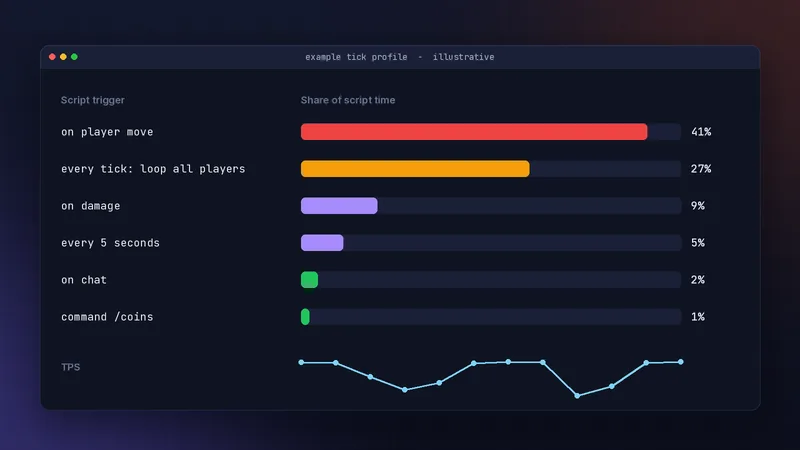
Skript parses scripts into its own structures and evaluates them at runtime, which adds overhead compared with compiled Java. The cost is small per action but multiplies when code runs on every tick or every movement.
Why most servers never notice
Commands, joins, deaths and timers fire rarely in computer terms. A server running dozens of event-driven scripts usually spends far more time on world ticking and entities than on Skript. Problems tend to come from a few hot scripts, which our performance guide shows how to find.
Capabilities and limits
What Skript covers out of the box
Events, commands, items, inventories, players, entities, worlds, variables, functions, timers and text formatting. That covers the bulk of community server customisation. Skript also handles persistence through its own variable storage, so features like balances, homes and cooldowns need no extra setup. Where it falls short is complex data modelling, external APIs and anything that needs fine control over threads.
Reaching further with addons
Addons add NBT, scoreboards, GUIs, files and SQL, and skript-reflect can call Java directly. At that point you are writing Java-shaped logic in Skript syntax, which is often the moment to consider a real plugin. See the best addons for the options.
Maintenance over time
Updates and breaking changes
Both approaches face Minecraft updates. Skript absorbs many API changes for you, but its own feature releases sometimes change syntax, and addons must keep up. Java plugins break when APIs change, but the compiler tells you exactly where.
Team skills
A script can be maintained by anyone who reads the docs. A Java plugin needs a developer. Think about who will fix things at midnight when the server breaks. On small community servers the owner is often the only technical person, which is a strong argument for keeping as much as possible in Skript. On larger teams with developers, the balance shifts toward Java for anything shared across servers.
A hybrid approach
Prototype in Skript, port the hot path
Build the feature in Skript, test it with players, then move only the parts that profiling shows are expensive into a small Java plugin. You keep the speed of iteration for the 90 percent of the feature that changes often, and spend development time only where it measurably helps. Many owners find that after profiling, nothing needs porting at all.
Keep the boundary clear
Let Java own heavy logic and data, and let Skript handle commands, messages and glue. Document which file owns which job so nobody fixes the same feature in two places. A simple rule works well: if a value is calculated in Java, Skript only displays it, and if a message or command lives in Skript, Java never duplicates it.
Frequently asked questions
Is Skript slower than Java plugins?
Yes, per action Skript has more overhead than compiled Java. For typical event-driven scripts the difference is rarely noticeable; it matters for code running every tick or on every movement.
Can Skript do everything a Java plugin can?
Not on its own. Core Skript covers most common features, addons extend it, and skript-reflect can call Java, but complex systems remain easier to build and test in Java.
Should beginners learn Skript before Java?
It is a gentle start for logic such as events, conditions and loops. If your goal is professional plugin development, plan to move on to Java afterwards.
Written and checked by the SkriptPlugin Editorial Team against Skript 2.16.2 on Paper. Syntax can change between releases, so confirm details in the official documentation for your version. Read our editorial policy.